
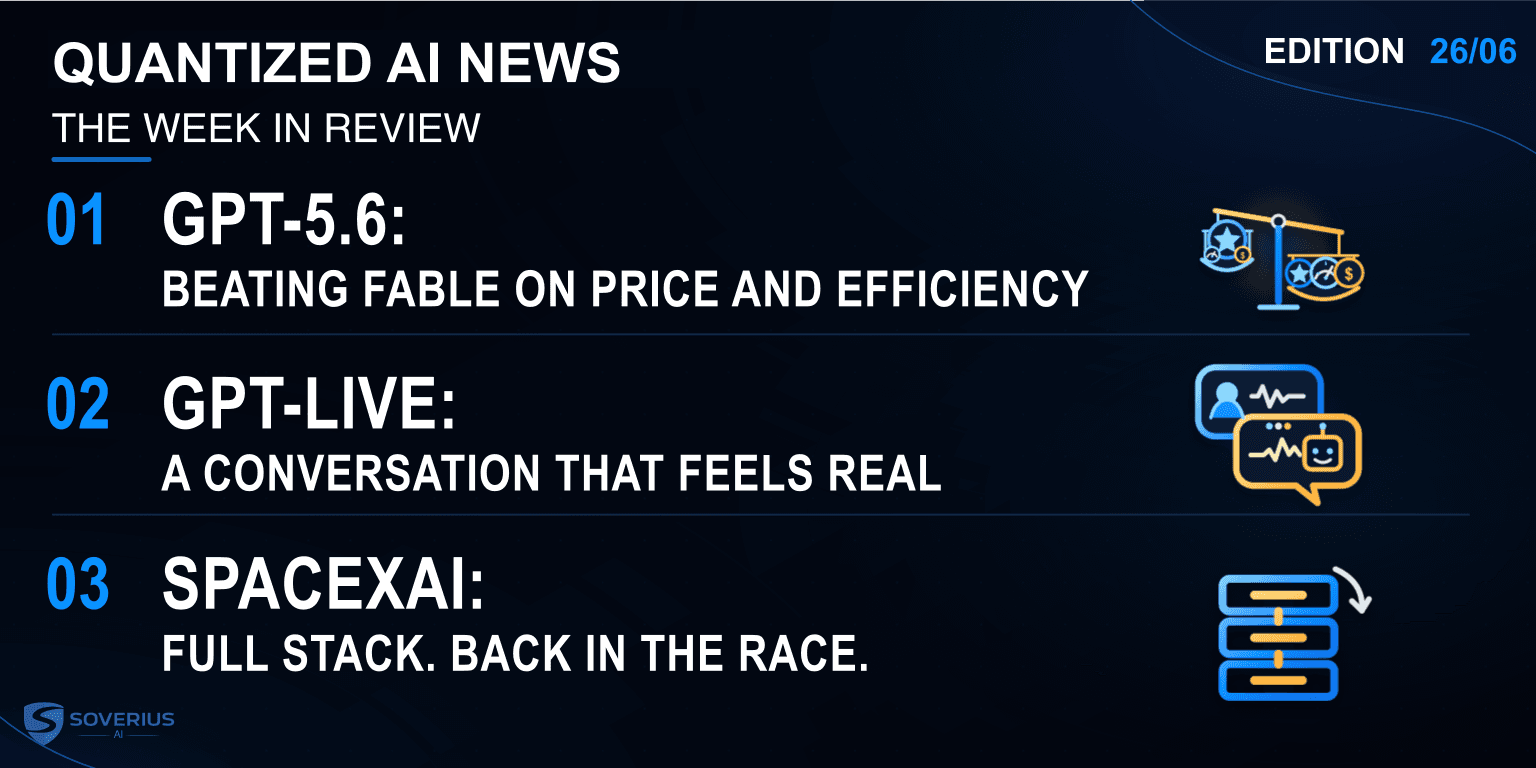
The best model is not necessarily the one at the top of every benchmark. GPT‑5.6 does not consistently beat Fable, but its combination of near-Fable quality, fewer tokens per task, and a lower price per token might make it the best model we currently have. GPT‑Live does two things at once: it listens and speaks. Meanwhile, SpaceXAI and Cursor are creating one of the industry’s most vertically integrated AI stacks.
GPT‑5.6: More Work From Every Token
GPT‑5.6 was released last week. We already discussed the pre-release in a previous edition, so we will keep this section focused. Its performance is close to Fable, but it comes with lower prices and better token efficiency, which we will discuss below.
The family consists of three models: Sol, Terra, and Luna, with Sol being the most powerful. Sol leads Fable on some benchmarks, while Fable leads on others.
OpenAI reports the following results:
| Benchmark | GPT‑5.6 Sol | Fable 5 |
|---|---|---|
| Agents’ Last Exam | 52.7% | 40.5% |
| Artificial Analysis Coding Agent Index | 80.0 | 77.2 |
| GDPval-AA v2 | 1,747.8 Elo | 1,759.6 Elo |
| SWE-bench Pro | 64.6% | 80.0% |
| Toolathlon | 58.0% | 61.7% |
OpenAI also challenged the design of the popular SWE-bench benchmark, which is based on real-world issues and changes from public and private software repositories. The problem is that the task descriptions are not always complete. Some requirements may have been clarified in discussions or comments that are not included in the benchmark. Hidden tests are normal, but some enforce implementation details that were never specified. A model can therefore implement the requested behavior correctly and still fail because its implementation differs from the one expected by the tests.
If the repository, issue discussion, or final patch appeared in the training data, parts of the solution may have been trained into the model. That would be data contamination. Alternatively, the model might simply get lucky and produce the specific implementation expected by the hidden tests.
That introduces measurement noise and makes the benchmark less reliable.
These concerns had already been raised about SWE-bench Verified, and SWE-bench Pro was intended to address them. OpenAI now argues that many of the same problems remain. After auditing SWE-bench Pro, OpenAI estimates that around 30% of its tasks are broken, undermining its earlier recommendation to use the benchmark.
Security
Security is also a big topic. OpenAI used a limited preview and worked with US government agencies before the broad release. Unlike Fable, GPT‑5.6 was not first released publicly and then withdrawn. Sam Altman later said government testers identified problems and that OpenAI made “many changes” during the process. Axios described the later release as receiving a government “green light,” while the White House disputed that characterization and emphasized that OpenAI did not legally require government approval.
OpenAI also uses a Preparedness Framework to evaluate the risks and guardrails of its models.
Token efficiency
In a CNBC interview, OpenAI CEO Sam Altman claimed that GPT‑5.6 Sol is:
“54 percent more token efficient on agentic coding tasks” and “as good or better as the other best models out there.”
OpenAI has not disclosed exactly how it achieved the improvement in token efficiency. Its release describes two different layers of efficiency. GPT‑5.6 itself uses fewer output tokens on several benchmarks, while the blog also highlights Programmatic Tool Calling.
In a conventional direct tool-calling loop, each tool result is typically returned to the model. Because repeated results become part of its context, tokens can quickly pile up.
With Programmatic Tool Calling, the model writes a JavaScript program that orchestrates the tools. It can query sources in parallel, run loops and conditions, calculate final prices, and filter the results. Intermediate data can remain inside the isolated runtime, allowing the program to return a much smaller result to the model.
However, Programmatic Tool Calling is not unique to OpenAI. Anthropic introduced a feature under the same name in November 2025.
Programmatic Tool Calling may therefore contribute to the efficiency of GPT‑5.6 workflows. But because Anthropic already offers the same approach, it cannot by itself explain why GPT‑5.6 would be more token-efficient than Claude. The remaining improvement may come from changes to the model, its training, or other parts of OpenAI’s agent system that the company has not disclosed.
Analysis
Although GPT‑5.6 does not outperform Fable on every benchmark, it might still come out ahead in practice. The key is the total cost rather than the winner of any single evaluation. Where the quality gap is small, proper harness engineering may close it, while GPT‑5.6’s lower token prices and lower output-token usage can make the resulting work substantially cheaper. GPT‑5.6 is therefore not just about token efficiency. The tokens themselves are also cheaper than Fable’s.
That leaves a larger positioning question: is GPT‑5.6 OpenAI’s answer to Fable, or is it closer to an Opus 4.8-class contender? One recent report from @synthwavedd claims that GPT‑5.6 will be the final model in the 5.x series and that GPT‑6 will use a significantly larger pretrain intended to compete more directly with Fable 5 and a forthcoming Fable 5.1. OpenAI has not confirmed these details or the suggested release window. GPT‑6 may therefore become the true Fable counterpart, but for now that remains an informed rumour.
Sources
- OpenAI: GPT‑5.6 release
- OpenAI: SWE-bench Pro audit
- OpenAI: GPT‑5.6 System Card
- OpenAI: GPT‑5.6 limited preview
- Axios: GPT‑5.6 government testing and release
- OpenAI: Programmatic Tool Calling
- Anthropic: Advanced tool use and Programmatic Tool Calling
- CNBC interview transcript with Sam Altman
- @synthwavedd: Report on GPT‑6 and Fable 5.1
GPT‑Live can listen while it speaks
OpenAI released GPT‑Live last week. The most visible change is that ChatGPT reacts while the user is still speaking, offering acknowledgements such as “mhmm” or “I see” and making the interaction much more responsive. In fact, during our testing, we sometimes could not tell whether we were talking to a person or an AI. Responsiveness is only part of what makes it feel more real. The voice is no longer perfectly neutral but includes pauses, intonation, and fillers such as “um.”
This is the third major generation of voice interaction in ChatGPT. The original Voice Mode used a pipeline with three separate models: the first converted speech into text, the second produced the answer, and the last converted that answer back into speech. This worked, but responses were slow. Users also had to deliver a complete thought in one go; otherwise, the system could begin processing too soon and lose the conversational pace.
Advanced Voice Mode was the second generation and was faster. The model could process and generate audio directly, so no separate speech-to-text step was necessary. This made the conversation faster and more natural. However, it remained turn-based: the user spoke first, and once the system detected a certain period of silence, the model began to answer.
GPT‑Live introduces what OpenAI calls full-duplex communication. While the user speaks, the model continuously processes the audio. It makes interaction decisions multiple times per second, allowing it to give intermediate feedback and respond quickly. Simply put, the conversation is no longer turn-based.
This does not mean that GPT‑Live has to formulate a complete answer in less than a second. It might initially decide only to say “mhmm,” continue listening or begin with a short response. More difficult tasks are delegated to a frontier model in the background. GPT‑Live currently uses GPT‑5.5 for that deeper work: GPT‑5.5 Instant for the lower reasoning settings and GPT‑5.5 Thinking for the higher settings.
OpenAI has not published an exact latency figure for GPT‑Live. However, the company previously reported audio response times as low as 232 milliseconds and an average of 320 milliseconds for GPT‑4o.
Analysis
Anything that improves the responsiveness of audio interaction is a big step forward. Speaking is a more natural way for us to communicate and often a much faster way to convey information. In the future, if these systems can reliably interpret emotional cues in speech, voice could add another valuable layer of context.
Writing things down is still important, especially for complex tasks. But for most interactions, speaking is the faster way.
Many users already rely on third-party dictation products such as Wispr Flow to turn speech into text faster than they can type. The open question is how well voice-first workflows function in an open-plan office, but that is a challenge for another day.
Sources
- OpenAI: Introducing GPT‑Live
- OpenAI: GPT‑Live System Card
- OpenAI: Hello GPT‑4o
- Wispr Flow: Voice dictation
SpaceXAI returns with Grok 4.5
SpaceXAI released Grok 4.5, which is available in Cursor. It is the first Grok model trained jointly with Cursor and is focused on coding, agentic tasks, and knowledge work. Its published results suggest that it closes much of the gap to the frontier, landing broadly near Opus 4.8 and within reach of GPT‑5.6, although Fable remains stronger overall.
Cursor’s access to developer interaction data gave the companies material they could use to train and improve Grok 4.5. Cursor already had its own model family, Composer, which was also trained on developer interaction data. Composer 2.5 was its latest model when Grok 4.5 launched. SpaceX has agreed to acquire Cursor, but the transaction is not yet complete and is expected to close in the third quarter of 2026.
SpaceXAI prices the model at USD 2 per million input tokens and USD 6 per million output tokens.
Analysis
SpaceX is developing into a full-stack vendor, approaching the way Google operates. Through its planned acquisition of Cursor, it would add an IDE and agent distribution to Grok Build. The partnership already spans two model families, Composer and Grok. SpaceX also controls the underlying Colossus infrastructure and, according to its IPO prospectus, sells compute capacity to third parties, including Anthropic.
In terms of controlling the environment, SpaceX is therefore becoming a major player. It would control most of the stack, from compute infrastructure and models to the agent and developer interface. The main difference from Google is that SpaceX does not yet produce its own AI accelerators and remains dependent on NVIDIA and other vendors, whereas Google has its own TPUs.
Sources
- SpaceXAI: Introducing Grok 4.5
- Cursor: Introducing Grok 4.5
- SpaceX: Cursor merger agreement
- SpaceX: IPO prospectus
- Google DeepMind: Gemini models and benchmark results
The Last Word
Before we close, a short announcement: Soverius will give an online talk at AI Fireside on Thursday, 23 July, at 17:00 CEST. AI Fireside is a new online format focusing on AI topics.
The talk will be beginner-friendly. Murat and Rainer will discuss different ways to overcome context-window limitations and work with more information than a model can handle at once.
Angular developers may also want to keep an eye on CopilotKit's X account this Thursday. There may be some news worth watching.