


Stay Updated
Get new essays and workshop announcements in your inbox.
The demo: MacroQuest in two prompts
MacroQuest is a working app shell with daily goals, a live macro dashboard, recent meals, and a CopilotKit chat panel, backed by a local Gemma model through llama.cpp. The demo turns on two prompts, each exercising a different kind of generated UI.
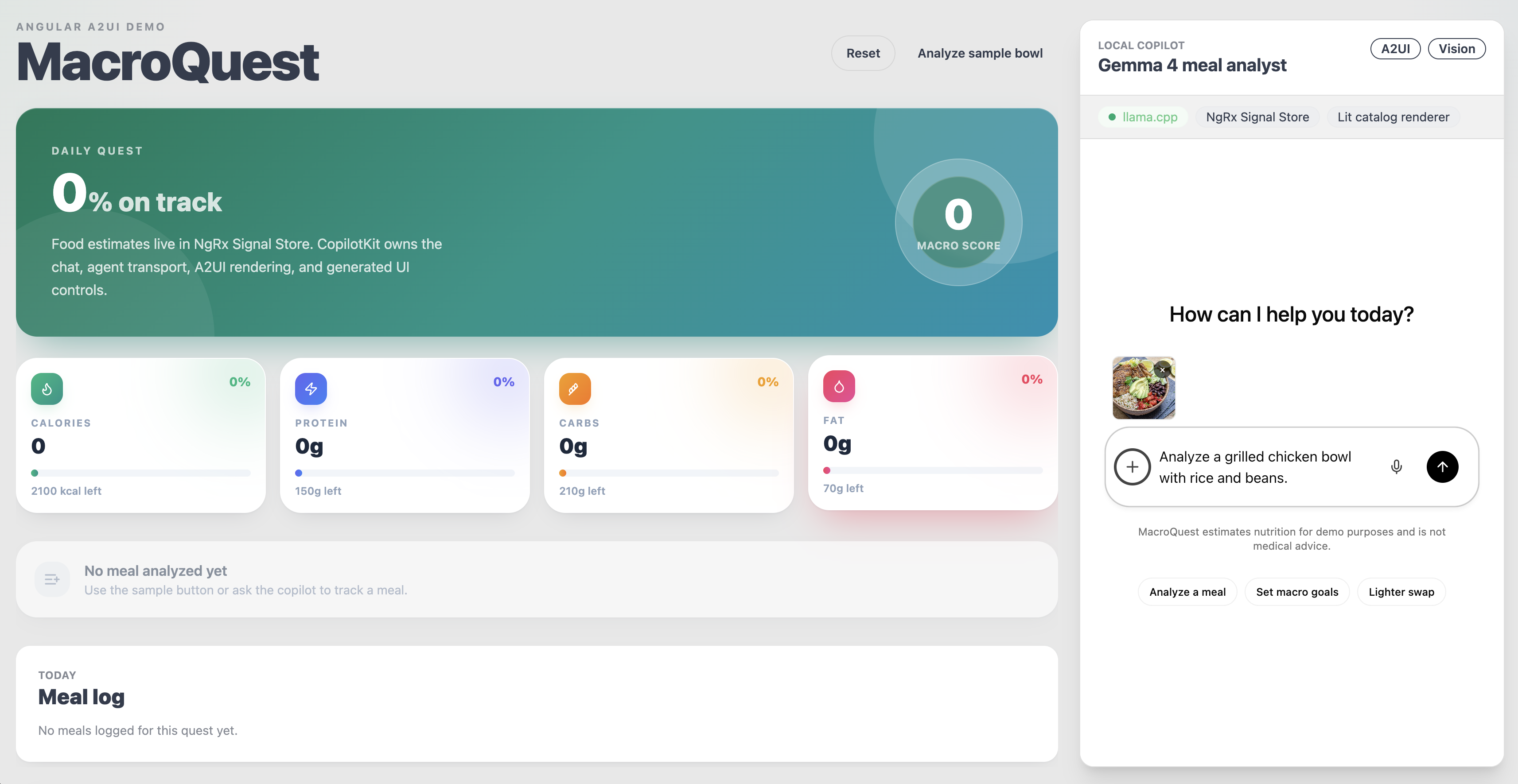
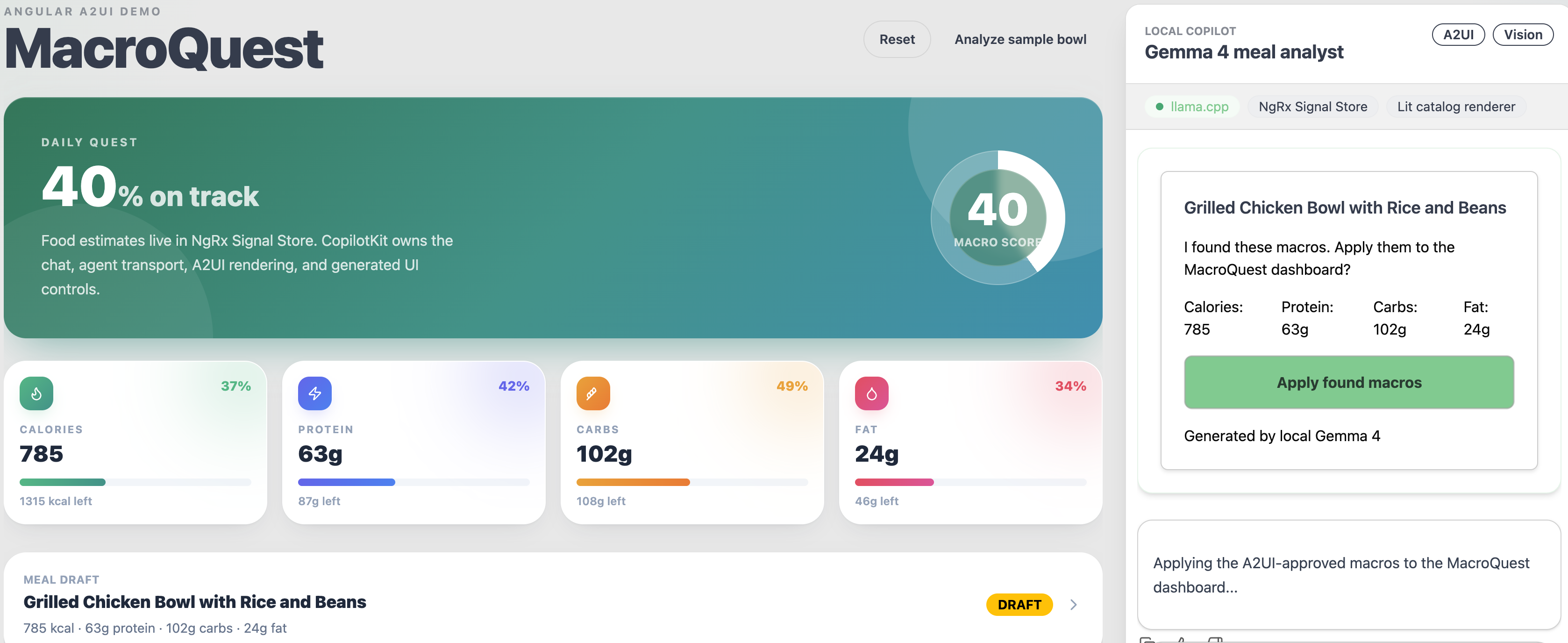
Prompt 1 — a rich A2UI surface:
Analyze a grilled chicken bowl with rice and beans.
Gemma authors an A2UI component tree. The premade Angular renderer paints it as a meal card in the chat stream, and the draft lands in the store as the selected meal.
Prompt 2 — an Open Generative UI sandbox:
Suggest a lighter version of my current meal.
This time the agent generates an interactive UI inside a sandbox iframe. Its controls call back into the app through a sandbox function to apply the lighter swap, kept deliberately separate from trusted state.
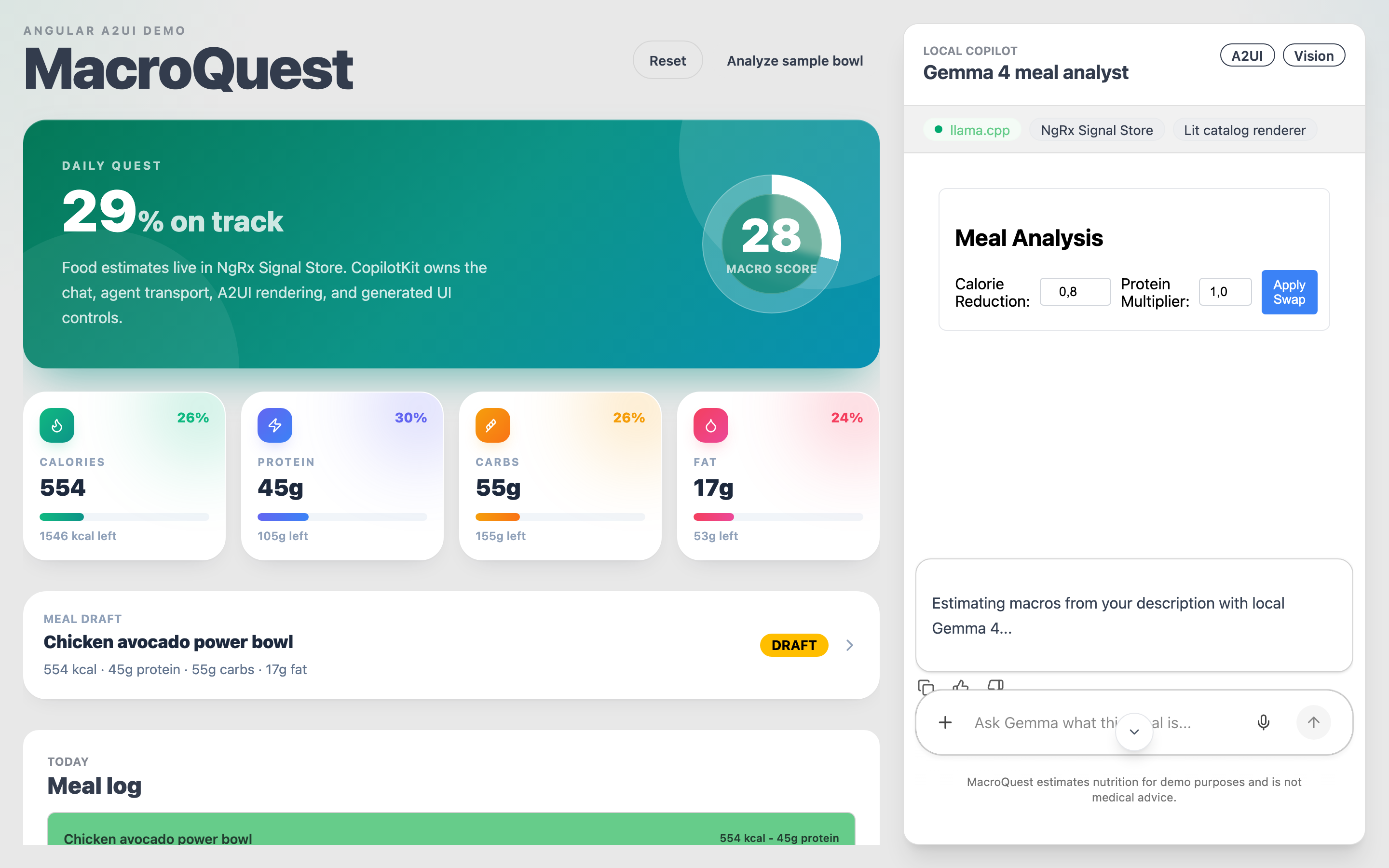
The dashboard never re-renders from the agent's word — it recomputes from the store. The agent proposes; the store decides.
The integration is small
All of the code below is real code from the MacroQuest repo. Mounting the full chat experience is one component:
<copilot-chat [attachments]="store.mealPhotoAttachments" />Wiring the runtime is declarative app config, including the sandbox function that Prompt 2's generated UI calls back into:
provideCopilotKit({ runtimeUrl: '/api/copilotkit', a2ui: { includeSchema: true }, openGenerativeUI: { sandboxFunctions: [ { name: 'applyMacroSwap', description: 'Apply a generated lighter macro swap to the selected MacroQuest meal.', parameters: macroSwapSandboxSchema, handler: applyMacroSwapFromSandbox, }, ], },});The agent integration itself lives next to your state, not scattered through components. In MacroQuest it's an NgRx signalStoreFeature called withCopilot(), whose onInit hook does two things. First, it exposes trusted state to the agent — a computed over store signals, so the context the agent sees is always current:
const agentContext = computed(() => ({ description: 'MacroQuest trusted Angular state from NgRx Signal Store. ' + 'Use this context before proposing meal updates.', value: JSON.stringify({ activeDate: store.activeDate(), goals: store.goals(), dailyTotals: store.dailyTotals(), remaining: store.remaining(), selectedMeal: store.selectedMeal(), }),}));connectAgentContext(agentContext);Second, it registers the tools the agent may call. Here's setMacroGoals in full — Zod schema, handler, and all:
registerFrontendTool<MacroGoalsToolArgs>({ name: 'setMacroGoals', description: 'Update MacroQuest daily macro goals in the Angular NgRx Signal Store.', parameters: z.object({ calories: z.number().optional(), protein: z.number().optional(), carbs: z.number().optional(), fat: z.number().optional(), }), handler: async (goals) => { store.setGoals(goals); return { ok: true, goals: store.goals() }; },});Its sibling logMealDraft follows the same pattern with a richer schema for food items. Note what the tool is: a narrow, typed mutation into state you control. The agent can't reach anything else.
The sandbox side is even more constrained. The generated UI runs in an iframe and can only call the functions you listed in sandboxFunctions. The handler is a plain module function that refuses to act when the app isn't in a state to accept the change:
export async function applyMacroSwapFromSandbox(input: MacroSwapSandboxArgs) { if (!sandboxStore) { return { ok: false, message: 'MacroQuest is not ready yet.' }; } const meal = sandboxStore.applyMacroSwap(input); if (!meal) { return { ok: false, message: 'Analyze or select a meal before applying a sandbox swap.' }; } return { ok: true, mealId: meal.id, title: meal.title, totals: getMealTotals(meal) };}That's the whole shape: declarative provider config, one chat component, and a thin, typed boundary between the agent and your state. The full technical deep-dive walks the entire build.
What "we maintain it" means
- Tracks core:
@copilotkit/angularreleases alongside the CopilotKit core version line. - Stays current with Angular: keeping peer ranges live, with Angular 22 support as the next milestone (the demo already runs on 22 ahead of the package).
- Docs and examples: shipping the Angular quickstart and keeping a reference app (MacroQuest) on recent Angular + NgRx Signals.
- Upstream-first: the work ships in CopilotKit/CopilotKit itself, and the Angular A2UI work is already merged into
main. Stewardship, not a fork. - React v2 parity as the goal: DI/signals idioms (not literal React hook names), test depth, and API completeness.
Honest status: Angular isn't widely used in CopilotKit production yet, and there are gaps versus React — tests, CI, docs, API surface. During this catch-up phase, expect occasional breaking changes.
The work so far
The Angular work is merged into CopilotKit main:
- Murat Sari — A2UI support for Angular (6a768ab7d), chat and transcription improvements (ebcbb19ea), OpenRouter support (800b55dac).
- Rainer Hahnekamp (Angular GDE / NgRx Core Team) — modernized the Angular package to current standards (b5fa76d5f) and hardened the A2UI renderer (10245a35f).
Roadmap
- Angular 22 peer support + signals-first ergonomics.
- An Angular quickstart and API docs.
- A typed custom A2UI catalog (e.g.
MealScanCard,MacroRing) over the basic catalog. - More examples beyond food tracking, and ongoing parity tracking against the React SDK.
Stay Updated
Get new essays and workshop announcements in your inbox.


Comments
No comments yet. Be the first.